Do the Driving Modes in Cadillac Lyriq Offer Different Ranges or Battery Usages? Full Guide 2026

The Cadillac Lyriq is a luxury electric SUV designed to combine performance, comfort, and advanced energy efficiency in a single package. A common question among EV drivers is do the driving modes in Cadillac Lyriq offer different ranges or battery usages? The answer is yes, but not because the battery itself changes. Instead, each driving mode adjusts how power is delivered, how quickly energy is consumed, and how regenerative braking behaves. These changes directly affect real-world driving range depending on the selected mode. The system is engineered to adapt performance for different driving conditions while maintaining overall battery health. Understanding these differences helps drivers use energy more efficiently in daily driving. It also helps drivers choose the right mode for different road situations. It improves awareness of how electric power is managed inside the vehicle. It allows better prediction of driving range before every trip. It supports smarter and more efficient driving decisions. It ultimately helps maximize the overall performance of the Cadillac Lyriq. It also improves long-term battery optimization. It helps reduce unnecessary energy waste in daily use. It gives drivers better control over efficiency. It enhances understanding of EV driving behavior.
Who is this guide for
This guide is designed for Cadillac Lyriq owners, EV buyers, and anyone curious about how driving modes affect electric vehicle efficiency. It is especially helpful for drivers trying to maximize range and reduce charging frequency. If you are asking do the driving modes in Cadillac Lyriq offer different ranges or battery usages? this guide explains everything in simple terms. It also helps new EV users understand how driving style influences battery performance. The goal is to make real-world efficiency easier to understand. It also helps drivers compare different modes in practical conditions. Understanding these differences can improve long-term battery usage habits. It also supports better trip planning for longer journeys. Many EV owners benefit from learning how energy is distributed. This knowledge helps reduce unnecessary energy waste. It also improves overall driving confidence. It helps drivers make smarter mode selection decisions in daily use. It supports better understanding of EV technology behavior. It improves awareness of efficiency factors beyond just battery size. It also helps in reducing long-term charging costs. It gives a clearer picture of real-world driving expectations. It enhances decision-making for both city and highway travel. It supports efficient driving habits for all conditions.
Tour Mode Efficiency and Range Optimization
Why Tour Mode Delivers Maximum Range
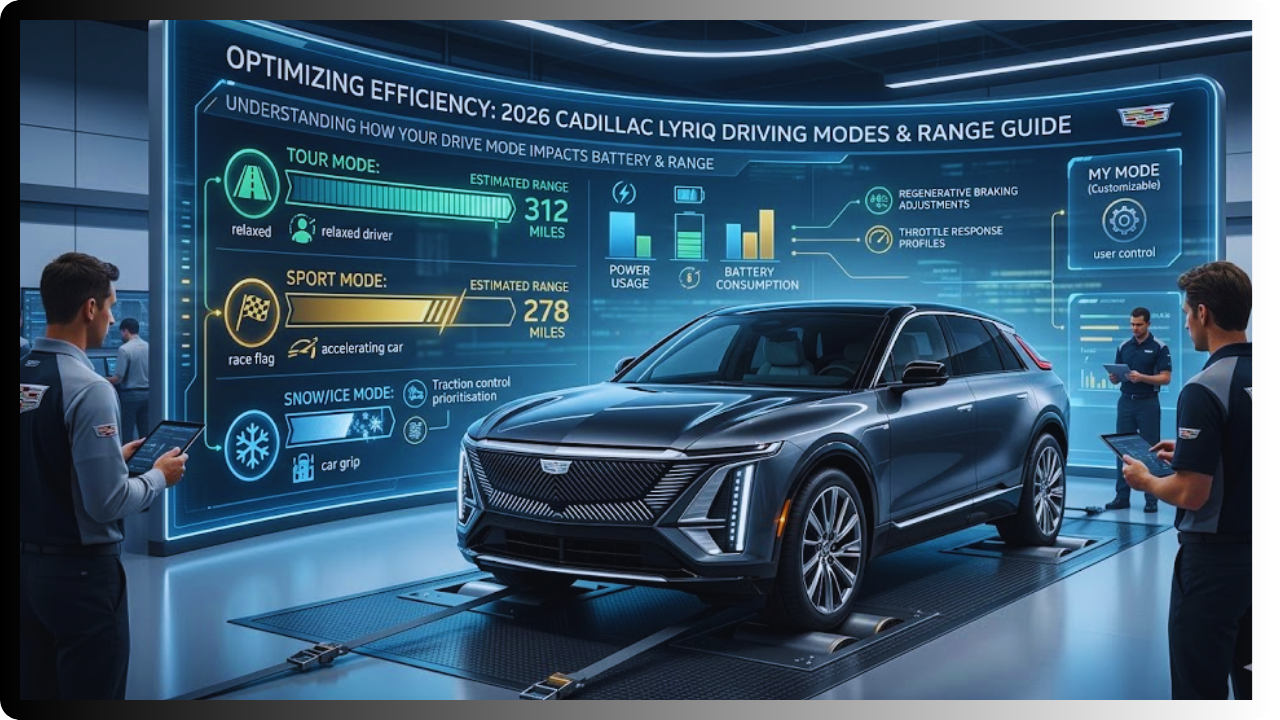
Tour mode is the primary efficiency-focused driving mode in the Cadillac Lyriq. It is designed for everyday driving and long-distance travel. The system smooths acceleration and reduces unnecessary power output to conserve energy. This helps the vehicle maintain steady energy consumption in both city and highway driving. Because of this balance, Tour mode provides the longest driving range among all modes. This directly answers do the driving modes in Cadillac Lyriq offer different ranges or battery usages? by showing how efficiency-focused settings extend range. The regenerative braking system also works more efficiently in this mode. Energy spikes are reduced, which prevents rapid battery drain. Drivers experience more predictable mileage per charge. It is ideal for commuting and highway cruising. It also reduces stress on the battery over long periods. It supports smoother acceleration patterns. It improves driving comfort and stability. It ensures consistent efficiency across conditions. It reduces unnecessary power loss during travel. It helps extend total trip range significantly.
Sport Mode Performance and Energy Consumption
How Sport Mode Reduces Driving Range
Sport mode is designed for performance and driving excitement in the Cadillac Lyriq. It increases throttle response and delivers power more aggressively. This results in faster acceleration but higher energy consumption. Because more energy is drawn from the battery, driving range is reduced compared to Tour mode. This clearly supports the question do the driving modes in Cadillac Lyriq offer different ranges or battery usages? by showing how performance settings affect efficiency. Sport mode is best used for short bursts of driving rather than long trips. The vehicle feels more responsive and dynamic in this setting. However, frequent use leads to quicker battery drain. Highway efficiency also decreases at higher speeds. It prioritizes speed and power over energy conservation. It increases driving excitement and responsiveness. It reduces overall efficiency significantly. It is not suitable for long-range driving. It increases power demand from the battery system. It delivers sharper acceleration response. It enhances sporty driving feel.
Snow Mode Stability and Efficiency Balance
How Snow Mode Impacts Battery Usage
Snow mode is optimized for low-traction conditions such as snow, ice, or wet roads. It reduces power delivery to improve traction and stability. This prevents wheel slip and enhances safety during difficult driving conditions. However, the system may use slightly more energy to maintain control. As a result, there can be a small reduction in driving range. This again relates to do the driving modes in Cadillac Lyriq offer different ranges or battery usages? because efficiency changes based on road conditions. Snow mode carefully balances safety and energy use. It distributes power more evenly across wheels. It improves handling in unpredictable weather. It ensures stable control on slippery surfaces. It is essential for winter driving safety. It slightly reduces efficiency compared to Tour mode. It prioritizes traction over energy savings. It enhances vehicle stability in harsh environments.
My Mode Customization and Flexibility
How My Mode Changes Efficiency Behavior
My Mode allows drivers to fully customize vehicle behavior in the Cadillac Lyriq. It lets users adjust steering, braking, and acceleration response. Depending on settings, it can behave like either an efficient or performance-oriented mode. If configured for aggressive driving, energy consumption increases. If configured for comfort or balance, efficiency improves. This makes do the driving modes in Cadillac Lyriq offer different ranges or battery usages? highly dependent on user preferences. My Mode provides the most flexibility among all settings. Drivers can tailor the experience to their driving style. It allows fine-tuning of energy recovery settings. It can replicate Tour or Sport mode behavior. It is ideal for personalized driving experiences. It increases customization options for drivers. It supports different driving personalities. It enhances control over efficiency and performance. It adapts to multiple driving conditions. It gives full control over driving dynamics.
Regenerative Braking Influence on Range
How Regenerative Braking Improves Efficiency
Regenerative braking is a key system that improves energy efficiency in the Cadillac Lyriq. It captures energy during braking and sends it back to the battery. Stronger regenerative settings increase energy recovery and extend driving range. Weaker settings reduce energy recovery and slightly lower efficiency. This system works alongside driving modes to affect overall consumption. It helps answer do the driving modes in Cadillac Lyriq offer different ranges or battery usages? because energy recovery varies with settings. It improves efficiency in stop-and-go traffic. It reduces reliance on external charging. It enhances city driving performance. It increases battery recharge during driving. It supports smoother energy recycling. It improves urban efficiency significantly. It reduces wasted braking energy. It enhances overall driving economy.
Driving Speed and Aerodynamic Impact
Why High Speed Reduces Range Faster
Driving speed has a major impact on battery consumption in the Cadillac Lyriq. Higher speeds increase air resistance, which requires more energy. This causes the battery to drain faster regardless of driving mode. Even efficient modes like Tour cannot fully offset high-speed energy loss. This directly relates to do the driving modes in Cadillac Lyriq offer different ranges or battery usages? because external factors also influence range. Maintaining moderate speed improves overall range significantly. Aerodynamic drag increases rapidly at higher speeds. Energy usage rises sharply on highways. Smooth driving helps conserve battery power. Speed control is essential for long-distance travel. It increases wind resistance significantly. It reduces efficiency on highways. It requires more continuous energy output. It impacts total trip range strongly.
Weather Conditions and Battery Efficiency
How Temperature Affects Range
Weather conditions significantly affect battery performance in the Cadillac Lyriq. Cold temperatures reduce battery efficiency and limit energy output. Hot temperatures increase energy demand due to cooling systems. These conditions reduce overall driving range regardless of mode. This supports do the driving modes in Cadillac Lyriq offer different ranges or battery usages? because environmental factors interact with driving settings. Heating and air conditioning systems consume additional energy. Battery chemistry is less efficient in cold weather. Range reduction is more noticeable in winter conditions. Summer cooling also impacts energy usage. Weather is a key external factor in EV performance. It affects energy consumption significantly. It increases HVAC system load. It reduces efficiency in extreme climates. It influences real-world range behavior.
Real World Driving Range Differences
How Modes Change Practical Range Results
In real-world conditions, driving modes significantly affect the Cadillac Lyriq’s range. Tour mode provides the highest efficiency and longest driving range. Sport mode reduces range due to aggressive power usage. Snow mode slightly reduces efficiency to improve traction and safety. My Mode varies depending on customization settings. These results confirm do the driving modes in Cadillac Lyriq offer different ranges or battery usages? because energy use changes across modes. Real-world driving rarely matches official estimates exactly. Driving habits play a major role in final range. Smooth driving improves efficiency across all modes. Mode selection directly impacts charging frequency. It highlights real-world variation in EV performance. It improves trip planning accuracy. It supports better energy management decisions. It increases awareness of efficiency factors.
Impact of Road Terrain on Energy Consumption
Hilly or mountainous roads increase energy demand significantly. Uphill driving consumes more battery power than flat roads. Downhill driving can recover energy through regeneration. Terrain directly influences range performance. It creates constant changes in energy load during driving. Steep inclines require sustained power output from the motor. Descents help improve energy recovery efficiency. Rough terrain can also reduce overall efficiency slightly. Road elevation changes make range prediction less accurate. Drivers may notice faster battery drop in uphill sections. Terrain variation affects long-distance trip planning. It also increases workload on the power system. It forces continuous energy adjustment. It changes regeneration frequency. It impacts motor load balance. It increases variability in consumption.
Influence of Traffic Conditions on Battery Usage
Heavy traffic increases stop-and-go driving patterns. This can either improve or reduce efficiency depending on braking style. Traffic conditions strongly affect real-world range. Frequent stopping allows regenerative braking energy recovery. However, constant acceleration wastes more energy. Traffic congestion leads to inconsistent energy consumption. Smooth driving in traffic improves efficiency significantly. Aggressive driving reduces battery performance in jams. Idle time also impacts overall efficiency. Urban congestion is one of the biggest EV range variables. Predicting range becomes harder in heavy traffic. Driving mode effects change based on traffic density. It directly impacts city driving efficiency. It increases stop-start energy cycles. It affects average speed significantly. It creates fluctuating consumption patterns. It impacts travel predictability.
Effect of Driving Distance on Efficiency Stability
Short trips may show lower efficiency due to startup energy use. Longer trips stabilize energy consumption patterns. Distance plays a role in accurate range prediction. Frequent stops and starts reduce early-trip efficiency. Battery and system warm-up also affects short trip performance. Longer journeys allow steady energy usage. Highway trips show more stable efficiency results. Short trips often exaggerate consumption rates. EVs perform better over extended distances. Distance smooths out energy fluctuations. Range estimates become more accurate on longer routes. Driving consistency improves over time. It reduces startup energy loss. It stabilizes motor temperature. It improves efficiency accuracy. It balances consumption over time.
Importance of Eco Driving Habits
Eco driving habits like gentle acceleration improve efficiency. Smooth steering and braking reduce energy waste. Driving style is critical for maximizing EV range. Consistent speed helps maintain battery stability. Avoiding sudden acceleration reduces energy spikes. Gentle braking improves regenerative recovery. Eco driving supports long-term battery health. It reduces unnecessary strain on the motor system. It improves overall driving comfort. It helps extend driving range significantly. It lowers energy consumption in all modes. It supports more predictable efficiency outcomes. It reduces mechanical stress. It improves traffic flow efficiency. It enhances driving smoothness. It promotes sustainable driving behavior.
Impact of Route Planning on Battery Performance
Efficient route planning reduces unnecessary stops and detours. Direct routes improve energy usage. Planning helps optimize total driving range. Shorter routes reduce overall battery consumption. Avoiding traffic-heavy roads improves efficiency. Navigation systems help optimize energy use. Route elevation also affects energy demand. Smart planning reduces driving stress. It improves arrival time accuracy. It helps manage charging stops better. It increases trip efficiency. It ensures better range utilization. It reduces wasted energy. It improves travel predictability. It supports better charging strategy. It enhances overall trip efficiency.
Role of Vehicle Software Intelligence
The Lyriq uses intelligent systems to optimize energy distribution. Software adjusts performance based on driving conditions. It improves efficiency automatically. Real-time adjustments improve battery usage. The system learns driving behavior over time. Energy output is optimized dynamically. Regenerative braking is intelligently controlled. Software enhances driving mode efficiency. It balances performance and economy. It reduces unnecessary energy waste. It improves system responsiveness. It ensures smoother energy management. It predicts energy demand. It adapts to terrain changes. It improves efficiency continuously. It enhances driving intelligence.
Effect of Battery Age on Range Performance
Older batteries may show slightly reduced capacity over time. This affects total driving range gradually. Battery aging is a natural process in EVs. Charge cycles slowly reduce maximum capacity. Environmental conditions also affect battery aging. Performance decline is usually gradual. Driving range may reduce slightly over years. Proper charging habits slow degradation. Temperature exposure impacts battery life. Usage patterns influence long-term efficiency. Battery health monitoring helps maintain performance. It ensures better long-term reliability. It reduces peak power output slightly. It increases internal resistance over time. It affects charging efficiency. It influences long-term range stability.
Influence of Charging Infrastructure Availability
Access to fast chargers affects long-trip planning. Better infrastructure reduces range anxiety. Charging availability impacts driving behavior decisions. Drivers plan routes based on charging stations. Limited infrastructure increases planning complexity. Fast charging improves travel flexibility. It reduces waiting time during trips. It allows longer journey coverage. Charging network density affects usability. Urban areas offer better charging access. Rural areas may require careful planning. Infrastructure improves EV adoption experience. It increases travel confidence. It supports long-distance mobility. It reduces charging stress. It enhances EV practicality.
Driver Awareness and Efficiency Optimization
Understanding vehicle behavior improves efficiency outcomes. Awareness of driving modes leads to smarter energy use. Knowledge directly improves EV performance. Informed drivers make better efficiency decisions. Understanding range factors reduces uncertainty. Experience improves driving optimization over time. Awareness helps reduce energy waste. It improves trip planning accuracy. It supports better mode selection. It increases confidence in EV driving. It enhances real-world performance. It leads to smarter energy management habits. It improves reaction to road conditions. It enhances decision-making during driving. It builds efficiency awareness. It supports long-term driving improvement.
FAQs
Does Cadillac Lyriq driving mode change battery size
No, all driving modes use the same battery capacity.
Which mode gives the longest range
Tour mode provides the highest driving range.
Does Sport mode reduce battery range
Yes, Sport mode uses more energy and reduces range.
Is Snow mode less efficient than Tour mode
Yes, Snow mode slightly reduces efficiency for safety.
Can driving style affect range more than modes
Yes, driving behavior has a major impact on range.
Final Thought
So, do the driving modes in Cadillac Lyriq offer different ranges or battery usages? Yes, they do, but only in how energy is managed, not battery capacity. Tour mode delivers maximum efficiency, Sport mode prioritizes performance, Snow mode improves traction, and My Mode adds customization flexibility. Combined with driving habits, speed, terrain, weather, traffic, and road conditions, these modes directly shape real-world driving range. The system intelligently adapts to different environments while protecting battery health. Understanding these factors helps drivers improve efficiency and reduce energy waste. It also supports better trip planning and smarter driving decisions. It enhances EV ownership experience significantly. It improves long-term battery usage habits. It increases awareness of energy consumption behavior. It helps drivers get the most from every charge.